

The ARLG advances its mission by developing and applying innovative tools, methods, and research resources that strengthen the design, conduct, and interpretation of clinical research focused on antimicrobial resistance.
Through close collaboration among its Scientific Leadership, and Clinical Operations, Laboratory, and Statistical and Data Management Centers, the ARLG has created novel analytic frameworks, trial designs, patient-centered outcomes, diagnostic evaluation methods, and shared research resources. These tools support the evaluation of diagnostic and treatment strategies and are designed to generate evidence that is both clinically meaningful and applicable to clinical care.
By making these methods and resources broadly accessible, the ARLG seeks to advance not only its own studies, but also the wider scientific community’s ability to address the evolving threat of antimicrobial resistance.
Expand each section below to learn more about ARLG’s research tools and methods, find access links, and explore other resources.
The ARLG provides funding and mentoring opportunities to early-stage investigators, including training on the ARLG’s innovative research tools and methods.
Learn more about ARLG innovations in Clinical Infectious Diseases
Patient-Centric Benefit-Risk Paradigm and Endpoints, and Strategy Trials Design
Desirability of Outcome Ranking (DOOR)
DOOR is a patient-centric paradigm for the design, analysis, interpretation, and reporting of clinical research that directly addresses the question most relevant to clinical decision making: how do patients’ overall experiences, considering both benefits and harms, compare between management options?
Traditional clinical trial design and analysis approaches typically assess outcomes one at a time, which can obscure cumulative benefits and harms experienced by individuals and complicate interpretation in the presence of competing risks. DOOR addresses these limitations by classifying each patient’s outcome into an ordered set of clinically meaningful categories that range from most to least desirable incorporating survival, clinical response, complications, and adverse events. Robust analysis methods are then implemented. This innovative benefit:risk evaluation aligns clinical research with the questions clinicians and patients face in real-world decision making.
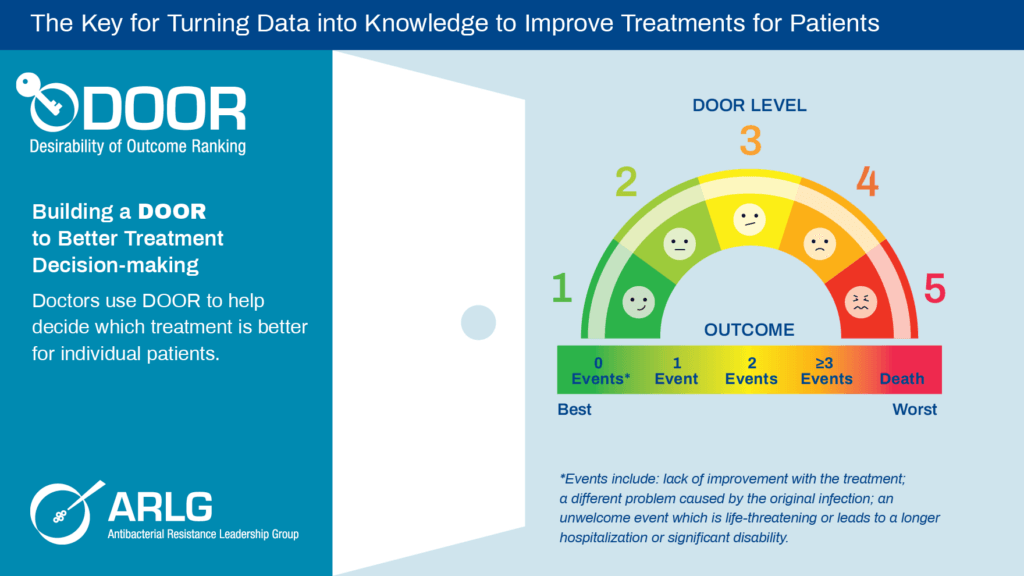
A wide range of ARLG studies have incorporated DOOR including PROVIDE, DOTS, PHAGE, SCOUT-CAP, and others. The ARLG, in collaboration with the National Institutes of Health (NIH), the US Food and Drug Administration (FDA), and patient advocate representatives, created standardized DOOR outcomes for use in trials for Staphylococcus aureus bloodstream infections, complicated urinary tract infections, complicated intra-abdominal infections, hospital-acquired/ventilator-associated bacterial pneumonia, and acute bacterial skin and skin-structure infections.

Access tools to design studies using the DOOR paradigm and for other DOOR analyses
DOOR Data Collection Tools for Investigator Assessment of Clinical Success and Complications
Note: DOOR Data Collection Tools are provided to help prospectively obtain data needed to use the ARLG-proposed DOOR endpoints. These DOOR tools are designed to be used in addition to a trial's standard data collection forms.
- Bacterial Skin and Skin Structure Infection (ABSSSI) Trials
- Complicated Intra-Abdominal Infection (cIAI) Trials
- Complicated Urinary Tract Infection (cUTI) Trials
- Hospital-Acquired and Ventilator-Associated Bacterial Pneumonia (HABP VABP) Trials
Learn more
Howard-Anderson J, Hamasaki T, Ge L, Collyar D, Cosgrove SE, Doernberg SB, Geres H, Gopinath R, Holland TL, King HA, Nambiar S, Rubin D, Chambers HF, Fowler VG, Evans SR, Boucher HW. Development and Application of a Desirability of Outcome Ranking (DOOR) Endpoint for Acute Bacterial Skin and Skin Structure Infections. Open Forum Infect Dis. 2026 Jun 22;13(6):ofag320. doi: 10.1093/ofid/ofag320. PMID: 42339770; PMCID: PMC13284871.
Doernberg SB, Tran TTT, Tong SYC, Paul M, Yahav D, Davis JS, Leibovici L, Boucher HW, Corey GR, Cosgrove SE, Chambers HF, Fowler VG, Evans SR, Holland TL; Antibacterial Resistance Leadership Group. Good Studies Evaluate the Disease While Great Studies Evaluate the Patient: Development and Application of a Desirability of Outcome Ranking Endpoint for Staphylococcus aureus Bloodstream Infection. Clin Infect Dis. 2019 May 2;68(10):1691-1698. doi: 10.1093/cid/ciy766. PMID: 30321315; PMCID: PMC6495020.
Evans SR, Rubin D, Follmann D, Pennello G, Huskins WC, Powers JH, Schoenfeld D, Chuang-Stein C, Cosgrove SE, Fowler VG Jr, Lautenbach E, Chambers HF. Desirability of Outcome Ranking (DOOR) and Response Adjusted for Duration of Antibiotic Risk (RADAR). Clin Infect Dis. 2015 Sep 1;61(5):800-6. doi: 10.1093/cid/civ495. Epub 2015 Jun 25. Erratum in: Clin Infect Dis. 2023 Jan 6;76(1):182. doi: 10.1093/cid/ciac352. PMID: 26113652; PMCID: PMC4542892.
Evans SR, Follmann D. Using Outcomes to Analyze Patients Rather than Patients to Analyze Outcomes: A Step toward Pragmatism in Benefit:risk Evaluation. Stat Biopharm Res. 2016;8(4):386-393. doi: 10.1080/19466315.2016.1207561. Epub 2016 Dec 6. PMID: 28435515; PMCID: PMC5394932.
Hamasaki T, He Y, Wu Q, Howard-Anderson J, Boucher HW, Doernberg SB, Holland TL, Powers JH 3rd, Wang J, Diao G, van Duin D, Fowler VG Jr, Chambers HF, Evans SR. A Patient-centric Paradigm and Tool for Clinical Research: The DOOR is Open. Antimicrob Agents Chemother. 2026 Jan 7;70(1):e0147825. doi: 10.1128/aac.01478-25. Epub 2025 Nov 24. PMID: 41277847; PMCID: PMC12777562.
Kinamon T, Waack U, Needles M, Rubin D, Collyar D, Doernberg SB, Evans SR, Hamasaki T, Holland TL, Howard-Anderson J, Chambers H, Fowler VG Jr, Nambiar S, Kim P, Boucher HW, Gopinath R. Exploration of a Potential DOOR Endpoint for Hospital-acquired Bacterial Pneumonia and Ventilator-associated Bacterial Pneumonia Using Six Registrational Trials for Antibacterial Drugs. Clin Infect Dis. 2024 Jul 19;79(1):60-69. doi: 10.1093/cid/ciae163. PMID: 38527855; PMCID: PMC11259224.
Kinamon T, Gopinath R, Waack U, Needles M, Rubin D, Collyar D, Doernberg SB, Evans S, Hamasaki T, Holland TL, Howard-Anderson J, Chambers H, Fowler VG, Nambiar S, Kim P, Boucher HW. Exploration of a Potential Desirability of Outcome Ranking Endpoint for Complicated Intra-Abdominal Infections Using 9 Registrational Trials for Antibacterial Drugs. Clin Infect Dis. 2023 Aug 22;77(4):649-656. doi: 10.1093/cid/ciad239. PMID: 37073571; PMCID: PMC10443999.
Howard-Anderson J, Hamasaki T, Dai W, Collyar D, Rubin D, Nambiar S, Kinamon T, Hill C, Gelone SP, Mariano D, Baba T, Holland TL, Doernberg SB, Chambers HF, Fowler VG, Evans SR, Boucher HW. Improving Traditional Registrational Trial End Points: Development and Application of a Desirability of Outcome Ranking End Point for Complicated Urinary Tract Infection Clinical Trials. Clin Infect Dis. 2023 Feb 8;76(3):e1157-e1165. doi: 10.1093/cid/ciac692. PMID: 36031403; PMCID: PMC10169394.
Howard-Anderson J, Hamasaki T, Dai W, Collyar D, Rubin D, Nambiar S, Kinamon T, Leister-Tebbe H, Hill C, Geres H, Holland TL, Doernberg SB, Chambers HF, Fowler VG Jr, Evans SR, Boucher HW; Antibacterial Resistance Leadership Group. Moving Beyond Mortality: Development and Application of a Desirability of Outcome Ranking (DOOR) Endpoint for Hospital-Acquired Bacterial Pneumonia and Ventilator-Associated Bacterial Pneumonia. Clin Infect Dis. 2024 Feb 17;78(2):259-268. doi: 10.1093/cid/ciad576. PMID: 37740559; PMCID: PMC10874265.
Desirability of Outcome Ranking for the Management of Antimicrobial Therapy (DOOR MAT)
DOOR MAT is a framework designed to evaluate and compare antimicrobial treatment selection strategies in the presence of drug resistance. DOOR MAT focuses specifically on the appropriateness and desirability of antibiotic choices informed by diagnostic results. It classifies treatment decisions based on whether the selected antibiotic is active against the pathogen and how narrowly targeted it is, reflecting the clinical principle that selecting the narrowest effective therapy appropriate for the infectious syndrome is most desirable. Antibiotic choices are organized along a scale that ranges from most desirable (effective and as narrow as possible), to least desirable (ineffective), incorporating the consequences of resistance, overtreatment, and undertreatment into a single, ordered measure.
Clinicians can use the DOOR MAT method to evaluate the desirability of different antibiotic choices (i.e., how well treatment options align with the principles of antimicrobial stewardship). DOOR MAT is also used in studies to assess the impact of rapid diagnostic test results to guide treatment decisions for bloodstream infections.
Learn more
Wilson BM, Jiang Y, Jump RLP, Viau RA, Perez F, Bonomo RA, Evans SR. Desirability of Outcome Ranking for the Management of Antimicrobial Therapy (DOOR MAT): A Framework for Assessing Antibiotic Selection Strategies in the Presence of Drug Resistance. Clin Infect Dis. 2021 Jul 15;73(2):344-350. doi: 10.1093/cid/ciaa1769. PMID: 33245333; PMCID: PMC8516503.
Response Adjusted for Duration of Antibiotic Risk (RADAR)
RADAR is an innovative framework adapted from the Desirability of Outcome Ranking (DOOR) for evaluating strategies to optimize antibiotic use in clinical trials. The guiding principle of RADAR is that while reducing antibiotic use to prevent resistance is desirable, it should never compromise patient outcomes.
RADAR works by assigning all clinical trial participants to a DOOR that categorizes them by an overall clinical outcome. The DOOR ranks participants using two rules:
- For patients with different overall clinical outcomes, the patient with a better overall clinical outcome receives a higher rank.
- For patients with the same overall clinical outcome, the patient with a shorter duration of antibiotic use receives a higher rank.
RADAR accounts for real-world relevance by evaluating treatment strategies based on how they are implemented, which includes patient adherence to the assigned regimen. It typically uses days of antibiotic therapy as the measure but can also incorporate other metrics such as dose count, intensity, antibiotic class, and delivery method. This holistic approach allows researchers to compare and identify superior treatment strategies that balance effective care with responsible antibiotic stewardship.
Learn more
Evans SR, Rubin D, Follmann D, Pennello G, Huskins WC, Powers JH, Schoenfeld D, Chuang-Stein C, Cosgrove SE, Fowler VG Jr, Lautenbach E, Chambers HF. Desirability of Outcome Ranking (DOOR) and Response Adjusted for Duration of Antibiotic Risk (RADAR). Clin Infect Dis. 2015 Sep 1;61(5):800-6. doi: 10.1093/cid/civ495. Epub 2015 Jun 25. Erratum in: Clin Infect Dis. 2023 Jan 6;76(1):182. doi: 10.1093/cid/ciac352. PMID: 26113652; PMCID: PMC4542892.
Sequential, Multiple-Assignment, Randomized Trials for Comparing Personalized Antibiotic Strategies (SMART COMPASS)
SMART COMPASS is an innovative clinical trial design that compares and optimizes personalized antibiotic treatments. This method allows researchers to evaluate multiple strategies for managing patient treatments, adjusting therapies as needed when resistance or intolerance is detected.
The SMART COMPASS approach closely mirrors real-world clinical decision-making, where treatment plans are often adjusted based on new lab results or short-term patient response. Patients are first randomized to an initial antibiotic (empiric therapy), and if antimicrobial susceptibility testing (AST) shows resistance, are re-randomized to options of more appropriate therapy. This design supports dynamic, patient-focused care and helps identify which sequence of treatment decisions leads to the best outcomes.
The SMART COMPASS framework can efficiently compare several strategies at once yielding valuable data that can help guide clinical decision-making.
Learn more
Evans SR, Follmann D, Liu Y, Holland T, Doernberg SB, Rouphael N, Hamasaki T, Jiang Y, Lok JJ, Tran TTT, Harris AD, Fowler VG, Boucher H, Kreiswirth BN, Bonomo RA, Van Duin D, Paterson DL, Chambers H. Sequential, Multiple-Assignment, Randomized Trials for COMparing Personalized Antibiotic StrategieS (SMART-COMPASS). Clin Infect Dis. 2019 May 17;68(11):1961-1967. doi: 10.1093/cid/ciy912. PMID: 30351426; PMCID: PMC6522685.
Evaluation of Diagnostics
Intention-to-Diagnose
The ARLG recently described the intention-to-diagnose principle, similar to the intention-to-treat principle in therapeutic clinical trials. This innovative concept safeguards diagnostic test accuracy studies by defining how ‘non-positive non-negative’ test results are handled in statistical analyses. The intention-to-diagnose principle distinguishes different types of non-positive non-negative test results, such as invalid and equivocal results.
This principle ensures that diagnostic accuracy studies evaluate tests as they are used in real-world settings, not as they perform in selectively curated subsets of patients. Intention-to-diagnose includes all participants or samples intended for testing regardless of equivocal or invalid results. This approach preserves statistical integrity, avoids bias, supports generalizability, and yields results that inform clinical decision making.

Access the web-based app and instructions for Intention-to-Diagnose
Learn more
Evans SR, Pennello G, Zhang S, Li Y, Wang Y, Cao Q, Komarow L, Hamasaki T, Petrides V, Meier K, Galicia NP, Fowler VG Jr, Boucher HW, Doernberg SB, Banerjee R, Rigatto MH, Kreiswirth BN, Bonomo RA, Chambers HF, Patel R. Intention-to-Diagnose and Distinct Research Foci in Diagnostic Accuracy Studies. Lancet Infect Dis. 2025 Aug;25(8):e472-e481. doi: 10.1016/S1473-3099(25)00070-2. Epub 2025 Mar 27. PMID: 40158520.
MASTER Protocol for Simultaneously Evaluating Multiple Infection Diagnostics (MASTERMIND)
The ARLG developed the MASTERMIND strategy to advance infectious diseases diagnostics. MASTERMIND studies have been used to generate data necessary to support FDA clearance of new diagnostics and promote studies that might not have been feasible with conventional trial designs.
MASTERMIND studies use one participant’s sample(s) to evaluate multiple diagnostics at once, providing efficiencies of specimen collection and characterization. The protocol facilitates efficiency in studies through central trial organization, standardized methods and terms, and use of common comparators.
The MASTERMIND approach was first implemented in MASTERMIND-GC, a clinical trial of three rapid diagnostics for extragenital Neisseria gonorrhoeae and Chlamydia trachomatis diagnosis. After the MASTERMIND study design directly led to new FDA-cleared assays, the MASTERMIND-GC study was highlighted on Twitter/X by the US Food and Drug Administration (FDA) Commissioner Ned Sharpless, “Today, @US_FDA cleared for marketing 2 tests to detect chlamydia and gonorrhea through diagnostic testing of extragenital specimens, the first clearance for testing these infections via throat and rectum.”
The MASTERMIND protocol was also used in other ARLG studies:
- MASTERMIND-Pneumonia, a study to determine the accuracy of pathogen and host-directed testing for the diagnosis of Ventilator Associated Pneumonia (VAP),
- MASTERMIND-RING, a study to assess molecular detection of fluoroquinolone resistance in N. gonorrhoeae, and
- MASTER RADICAL, a study to assess rapid host-based diagnostics for sorting respiratory illnesses into viral or bacterial etiologies.
Learn more
Doernberg SB, Komarow L, Tran TTT, Sund Z, Pandori MW, Jensen D, Tsalik EL, Deal CD, Chambers HF, Fowler VG, Evans SR, Patel R, Klausner JD. Simultaneous Evaluation of Diagnostic Assays for Pharyngeal and Rectal Neisseria gonorrhoeae and Chlamydia trachomatis Using a Master Protocol. Clin Infect Dis. 2020 Dec 3;71(9):2314-2322. doi: 10.1093/cid/ciz1105. PMID: 31734695; PMCID: PMC7713680.
Adamson PC, Pandori MW, Doernberg SB, Komarow L, Sund Z, Tran TTT, Jensen D, Tsalik EL, Deal CD, Chambers HF, Fowler VG Jr, Evans SR, Patel R, Klausner JD; Antibacterial Resistance Leadership Group. Analytical Evaluation of the Abbott RealTime CT/NG Assay for Detection of Chlamydia trachomatis and Neisseria gonorrhoeae in Rectal and Pharyngeal Swabs. J Mol Diagn. 2020 Jun;22(6):811-816. doi: 10.1016/j.jmoldx.2020.03.004. Epub 2020 Apr 2. PMID: 32247863; PMCID: PMC7295135.
Patel R, Tsalik EL, Petzold E, Fowler VG Jr, Klausner JD, Evans S; Antibacterial Resistance Leadership Group (ARLG). MASTERMIND: Bringing Microbial Diagnostics to the Clinic. Clin Infect Dis. 2017 Feb 1;64(3):355-360. doi: 10.1093/cid/ciw788. Epub 2016 Dec 7. PMID: 27927867; PMCID: PMC5894935.
Benefit-Risk Evaluation for Diagnostics: A Framework (BED-FRAME) and Average Weighted Accuracy (AWA)
BED-FRAME and AWA are innovative methods developed to systematically assess and compare diagnostic tests in clinical decision-making. Unlike traditional metrics like sensitivity and specificity, BED-FRAME and AWA account for both the prevalence of conditions and the relative importance of false positives vs. false negatives, which vary based on location, time, and available treatments. This tailored approach helps clinicians make more informed decisions that are relevant to their specific context.
These tools have been used in the ARLG’s RADICAL study and in analyzing rapid tests for three “critical” priority pathogens identified by the World Health Organization: carbapenem-resistant (CR) Enterobacterales, CR Pseudomonas aeruginosa, and CR Acinetobacter baumannii. The results are presented in a way that adapts to changing circumstances, ensuring practical and relevant evaluations.
Access the tool for BED-FRAME and AWA analyses
Learn more
Evans SR, Pennello G, Pantoja-Galicia N, Jiang H, Hujer AM, Hujer KM, Manca C, Hill C, Jacobs MR, Chen L, Patel R, Kreiswirth BN, Bonomo RA; Antibacterial Resistance Leadership Group. Benefit-risk Evaluation for Diagnostics: A Framework (BED-FRAME). Clin Infect Dis. 2016 Sep 15;63(6):812-7. doi: 10.1093/cid/ciw329. Epub 2016 May 18. PMI: 27193750; PMCID: PMC4996133.
Liu Y, Tsalik EL, Jiang Y, Ko ER, Woods CW, Henao R, Evans SR. Average Weighted Accuracy: Pragmatic Analysis for a Rapid Diagnostics in Categorizing Acute Lung Infections (RADICAL) Study. Clin Infect Dis. 2020 Jun 10;70(12):2736-2742. doi:10.1093/cid/ciz437. PMID: 31157863; PMCID: PMC7286373.
Clinically Adjudicated Reference Standards for Infectious Diseases Diagnostics
Reference standard selection for evaluation of novel infectious diseases diagnostics can be challenging when the accuracy of a new test may exceed existing tests and/or when no gold standard exists. Clinically adjudicated reference standards are one possible solution to this challenge.
In addition to being helpful when no predefined test or composite of tests is sufficiently accurate, clinically adjudicated reference standards emulate clinical practice where all clinical information is assessed together. Examples of types of tests for which this might be useful include broad range pathogen detection directly from clinical specimens and host response-based assessment for infection.
The ARLG published this method for selecting and operationalizing clinically adjudicated reference standards in Clinical Infectious Diseases and has also recently published an approach for adjudication of rapid diagnostics that identify organisms directly from blood.
Learn more
Doernberg SB, Komarow L, Greenwood-Quaintance K, Schwager N, Mau D, Jensen D, Cosgrove SE, Evans S, Fowler VG Jr, Patel R; Antibacterial Resistance Leadership Group (ARLG). Clinical adjudication approach for rapid diagnostics aiming to identify bacteria directly from blood. Clin Microbiol Infect. 2026 Apr;32(4):512-515. doi: 10.1016/j.cmi.2025.12.007. Epub 2025 Dec 11. PMID: 41389990.
Patel R, Tsalik EL, Evans S, Fowler VG, Doernberg SB; Antibacterial Resistance Leadership Group. Clinically Adjudicated Reference Standards for Evaluation of Infectious Diseases Diagnostics. Clin Infect Dis. 2023 Mar 4;76(5):938-943. doi: 10.1093/cid/ciac829. PMID: 36262037; PMCID: PMC10226744.
Patient-Reported Tools
Patient-Reported Outcome Measures
ARLG investigators conducted a large, award-winning qualitative study in which they interviewed patients with Staphylococcus aureus or gram-negative bloodstream infections to learn about their experiences and identify high-level themes1, 2. Findings from the study interviews resulted in a health-related quality of life (HRQoL) concept map to inform future research. ARLG investigators then led a second study to further inform the assessment of HRQoL in patients with bloodstream infections. From this work, the team developed and published a survey from well-established patient-reported outcome measures (PROMIS®) that is uniquely tailored to bloodstream infections and captures what matters most to these patients as they recover.3 This survey was successfully used in the DOTS clinical trial.4
The ARLG has also supported projects on patient-centered outcome measurements in complicated urinary tract infections; complicated intrabdominal infections, acute bacterial skin and skin structure infections; and hospital-acquired and ventilator-associated pneumonia. Some of this work was featured in an ARLG supplement, “Measuring Health-Related Quality of Life in Antibacterial Trials: Listening, Learning, and Leveraging the Patient Perspective,” published August 2025 in Clinical Infectious Diseases.
A second study, "Comparing Patient and Clinician Perceptions of Health-Related Quality of Life in Urinary Tract Infections," was published in July 2026 in JAMA Network Open.
View an illustration comparing patient and clinician perceptions of complicated urinary tract infections, designed by Danielle Hennis.

Learn more
- King HA, Doernberg SB, Miller J, Grover K, Oakes M, Ruffin F, Gonzales S, Rader A, Neuss MJ, Bosworth HB, Sund Z, Drennan C, Hill-Rorie JM, Shah P, Winn L, Fowler VG, Holland TL. Patients' Experiences With Staphylococcus aureus and Gram-negative Bacterial Bloodstream Infections: A Qualitative Descriptive Study and Concept Elicitation Phase to Inform Measurement of Patient-reported Quality of Life. Clin Infect Dis. 2021 Jul 15;73(2):237-247. doi: 10.1093/cid/ciaa611. PMID: 32445467; PMCID: PMC8282311.
- McNamara JF, Davis JS. Measuring the Meaningful. Clin Infect Dis. 2021 Jul 15;73(2):248-249. doi: 10.1093/cid/ciaa616. PMID: 32445472.
- King HA, Doernberg SB, Grover K, Miller J, Oakes M, Wang TW, McFatrich M, Ruffin F, Staman K, Lane HG, Rader A, Sund Z, Bosworth HB, Reeve BB, Fowler VG Jr, Holland TL. Patients' Experiences With Staphylococcus aureus and Gram-Negative Bacterial Bloodstream Infections: Results from Cognitive Interviews to Inform Assessment of Health-Related Quality of Life. Open Forum Infect Dis. 2021 Dec 8;9(2):ofab622. doi: 10.1093/ofid/ofab622. PMID: 35106313; PMCID: PMC8801228.
- Turner NA, Hamasaki T, Doernberg SB, Lodise TP, King HA, Ghazaryan V, Cosgrove SE, Jenkins TC, Liu C, Sharma S, Zaharoff S, Wahid L, Renard VJ, Cook P, Raad I, Hachem R, Chaftari AM, Sims M, DeMarco C, Miller LG, McCarthy MW, Morse CG, Lucasti C, Forrest GN, Cherabuddi K, Polk C, Fazili T, Rupp ME, Thompson GR 3rd, Kim K, Strnad L, Schnee AE, McKinnell JA, Ramesh M, Silveira FP, McCarty TP, Lee TC, McDonald EG, Paolino K, Wiegand K, Wall A, Riccobene T, Patel R, Rappo U, Evans S, Chambers HF, Fowler VG Jr, Holland TL; Antibacterial Resistance Leadership Group. Dalbavancin for Treatment of Staphylococcus aureus Bacteremia: The DOTS Randomized Clinical Trial. JAMA. 2025 Aug 13;334(10):866–77. doi: 10.1001/jama.2025.12543. PMID: 40802264; PMCID: PMC12351474.
-
Howard-Anderson J, Brown M, Korn R, Miller J, Sutton K, Ruffin F, Burton S, Obi EN, Sidduri N, Watanabe AH, Yucel E, Bosworth HB, Boucher HW, Collyar D, Doernberg SB, Oakes M, Reeve BB, Fowler VG Jr, King HA; Antibacterial Resistance Leadership Group. Comparing Patient and Clinician Perceptions of Health-Related Quality of Life in Urinary Tract Infections. JAMA Netw Open. 2026 Jul 1;9(7):e2618822. doi: 10.1001/jamanetworkopen.2026.18822. PMID: 42536374; PMCID: PMC13428275.
Data Resources and Laboratory-Enabled Research Tools and Methods
Genomics Sequencing-based Typing, Epidemiology, Linkage, and Antimicrobial Resistance Tool (GENO-STELLAR)
GENO-STELLAR™ is a web-based genomic and epidemiologic platform that links Klebsiella pneumoniae whole-genome sequence data with detailed clinical and microbiologic metadata derived from isolates collected through ARLG studies. The platform enables investigation of antimicrobial resistance mechanisms and prediction of phenotypic antimicrobial susceptibility, as well as nearest‑neighbor–based inference through comparison with isolates in the ARLG K. pneumoniae database, by integrating genomic features with curated phenotypic susceptibility data, epidemiologic information, and clinical outcome data.
GENO-STELLAR™ provides real-time interactive reports, including phylogenetic analyses with tree-based visualizations and nearest-neighbor matching to ARLG isolates, in silico assessment of antimicrobial resistance genes, and phenotypic susceptibility prediction. Users submit assembled bacterial whole‑genome sequences (FASTA/FA/FNA format) for analysis.
Machine-Learning Based Analysis of Microbial Proteomics to Predict Antimicrobial Susceptibility
While researchers widely use matrix-assisted laser desorption/ionization time-of-flight mass spectrometry to quickly identify microbes from colonies, its use for resistance prediction is still limited. To help address this limitation, the ARLG used machine learning to analyze mass spectral profiles of Klebsiella pneumoniae isolates to determine whether the presence of K. pneumoniae carbapenemase (KPC) could be predicted. Ensemble learning strategies were applied to isolates from different geographic locations, with results validated using separate data sets. Two peak matrices were constructed and four machine learning algorithms applied, including combinations of ensemble models, and different classifiers.
Ensemble combinations resulted in classifier specificity of over 95%. Notably, the first annotated matrix-assisted laser desorption/ionization time-of-flight mass spectrometry spectrum for in silico prediction of protein masses in K. pneumoniae was made available from this work.
Learn more
Rodriguez-Temporal D, Gutiérrez-Pareja M, Gordy GG, Nahkala EM, Rodríguez-Sánchez B, Patel R. Prediction of KPC-producing Klebsiella pneumoniae by MALDI-TOF MS, Ensemble Learning, and Spectral Peak Annotation. J Clin Microbiol. 2026 May 13;64(5):e0146625. doi: 10.1128/jcm.01466-25. Epub 2026 Mar 30. PMID: 41910330; PMCID: PMC13170361.
ARLG Biorepository
The ARLG Biorepository catalogue is a web-searchable curated resource of well-characterized bacterial isolates generated through ARLG studies. The ARLG Biorepository website lists thousands of phenotypically and genotypically characterized isolates. It includes details about the antimicrobial resistance profile (with minimal inhibitory concentrations), genotypic profile (e.g., genetic characterization of β-lactamase genes), whole-genome sequence data with links to GenBank sequences, and links to publications (including PubMed ID) associated with the isolates.
Researchers have used isolates from the ARLG Biorepository to develop and evaluate novel diagnostics, characterize antimicrobial resistance mechanisms, and develop and test new therapeutics. For early-stage investigators pursuing antimicrobial research, ARLG isolates have helped in the generation of preliminary data for grants, phage hunting and testing, pharmacokinetic/pharmacodynamic (PK/PD) studies, and whole-genome sequencing and proteomic analyses.
The ARLG Biorepository is housed in a state-of-the-art facility at the Mayo Clinic, with a focus on quality and service, using a centralized, fully automated, and scalable system to support specimen processing, distribution, storage, and management.
Isolates are available to academic, government, and industry researchers free of charge through a simple online request after appropriate review and approval.
Phage Susceptibility Testing
The ARLG Laboratory Center and Statistical and Data Management Center have advanced phage susceptibility testing methods to support clinical research and evaluation of phage therapy in ARLG clinical trials. Because standardized and reproducible phage susceptibility methods have historically been lacking, ARLG investigators developed and evaluated testing approaches to assess phage activity against clinical bacterial isolates. This work supports rigorous clinical trials of phage therapy and aligns phage development with established principles used for antimicrobial susceptibility testing.
Learn more
Suh GA, Lodise TP, Tamma PD, Knisely JM, Alexander J, Aslam S, Barton KD, Bizzell E, Totten KMC, Campbell JL, Chan BK, Cunningham SA, Goodman KE, Greenwood-Quaintance KE, Harris AD, Hesse S, Maresso A, Nussenblatt V, Pride D, Rybak MJ, Sund Z, van Duin D, Van Tyne D, Patel R; Antibacterial Resistance Leadership Group. Considerations for the Use of Phage Therapy in Clinical Practice. Antimicrob Agents Chemother. 2022 Mar 15;66(3):e0207121. doi: 10.1128/AAC.02071-21. Epub 2022 Jan 18. PMID: 35041506; PMCID: PMC8923208.
Parmar K, Komarow L, Ellison DW, Filippov AA, Nikolich MP, Fackler JR, Lee M, Nair A, Agrawal P, Tamma PD, Souli M, Evans SR, Greenwood-Quaintance KE, Cunningham SA, Patel R; Antibacterial Resistance Leadership Group. Interlaboratory Comparison of Pseudomonas aeruginosa Phage Susceptibility Testing. J Clin Microbiol. 2023 Dec 19;61(12):e0061423. doi: 10.1128/jcm.00614-23. Epub 2023 Nov 14. PMID: 37962552; PMCID: PMC10729752.