

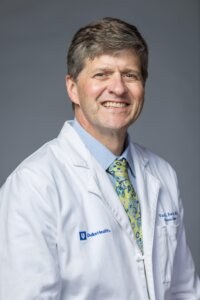
Vance G. Fowler, Jr., MD, MHS
Florence McAlister Distinguished Professor of Medicine
Professor, Department of Molecular Genetics and Microbiology
Duke University
What is your specialty and primary area of focus in your therapeutic area?
General infectious diseases
As one of two ARLG Principal Investigators (PIs), you have co-directed the ARLG since it began in 2013. Could you tell us what led you to that role?
Leading the ARLG has been an absolute blast. While not for the faint of heart, it provides an opportunity to pursue real solutions to the most pressing problems in antibacterial resistance—problems I see every time I’m on rounds in the hospital.
Also, in my 14 years as Co-Principal Investigator of the ARLG, I have never been bored. Stressed? Overwhelmed? Utterly baffled? Absolutely. But never once bored, and I’d take bewildered over bored any day of the week because the wins and the camaraderie make the challenges worthwhile.
Please tell us more about your role as an ARLG Principal Investigator, projects or groups that have been especially important to you, and other work that you would like to highlight.
Each group has made remarkable contributions that should make them enormously proud—I know I am. It is a profound privilege to be paid to think, especially when you’re working with some of the most talented investigators in the world. There is a lot to be learned when you are regularly not the smartest person in the room.
Could you tell us about some of your ARLG mentees and how you were able to support and guide their careers in antimicrobial resistance?
While I like to think that I have helped investigators like Tom Holland, Nick Turner, Sarah Doernberg, Ritu Banerjee, Mike Satlin, Pranita Tamma, David Roach, and Angelique Boutzoukas find their place, the truth is that our ARLG trainees tend to be highly self-motivated. As a result, I see my role as helping to identify talented individuals, give them a project and resources, and be available to troubleshoot. And what an honor it has been to do so.
Why is the ARLG’s mission important to you?
Antibacterial resistance is a real problem. I see its effects every time I enter the wards. Helping to address so profound a problem with creative solutions is one of the most important missions that I can think of.
In your opinion, what are some of the ARLG’s most important or impactful achievements so far?
Scott Evans’ Desirability of Outcome Ranking (DOOR) endpoint has transformed clinical trials design in infectious diseases.
The ARLG’s MASTERMIND concept—which arose from the simple observation that we used the same samples in the lab multiple times for different projects—has introduced a brand-new way to test diagnostics.
The Dalbavancin as an Option for Treatment of Staphylococcus aureus Bacteremia (DOTS) study is changing standard of care. The primary results paper was viewed more than 85,000 times on the JAMA website in the first year of its publication.
The SNAP, CRACKLE, and POP studies transformed our understanding of carbapenem-resistant bacteria and catalyzed friendships across the globe.
PHAGE, a multi-center randomized, placebo-controlled trial, laid the groundwork for rigorous scientific testing of bacteriophages.
FAST conducted an international randomized clinical trial of diagnostics to provide real answers about the clinical impact of a rapid susceptibility test in patients with Gram-negative bacteremia.
I am especially grateful for our emphasis on mentoring. The ARLG’s Mentoring Program, led by Anthony Harris, will probably be one of our most profound contributions to the field, continuing long after any of our individual projects.