

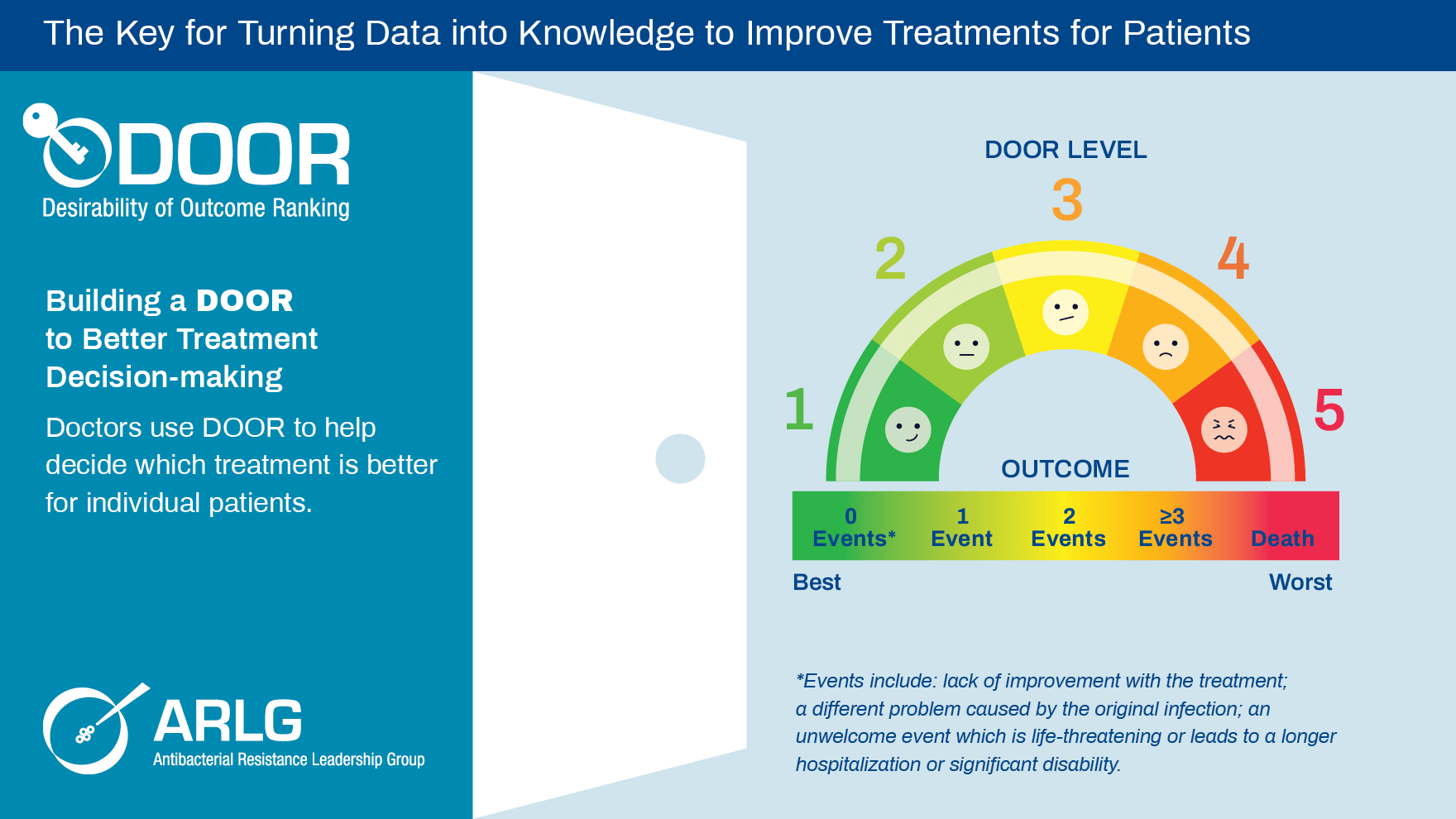
 ARLG’s Desirability of Outcome Ranking (DOOR) is a novel paradigm for the design, analysis, and interpretation of clinical trials that allows doctors to create better treatment strategies by giving them a way to review data and compare the risks and benefits of different interventional options. Doctors can then discuss the pros and cons for each option and tailor the strategy to fit the patient.
Scott Evans, PhD, developed this innovative paradigm with support from members of ARLG’s Statistical and Data Management Center (SDMC) Toshimitsu (Toshi) Hamasaki, Lauren Komarow, and Carol Hill. The goal of DOOR is to give doctors and researchers a method for informed therapeutic selection based on a comprehensive patient-centric benefit-risk evaluation. Researchers can apply DOOR’s paradigm to the design, data monitoring, and analyses of any clinical trial or observational study to evaluate the patient experience and guide therapeutic decision-making.

ARLG researchers first used DOOR in clinical studies for antimicrobial resistance, but now teams are benefitting by applying DOOR to studies in other disease areas such as COVID-19, tuberculosis, melioidosis, pulmonary artery disease, stroke prevention, status epilepticus, and maternal-fetal medicine.
Building a DOOR to Better Treatment Strategies
For doctors, the most important “real world” application of clinical trial data is to determine which therapeutic option is best for each patient. However, since randomized trial outcomes do not provide a clear way to review and compare data on patient-reported experiences, they often fail to provide the necessary evidence to inform day-to-day medical decision-making.
DOOR helps improve the real world applications of clinical trial data by correcting the usual arithmetic of analyzing outcomes separately. Instead of using patients to analyze outcomes, DOOR uses outcomes to analyze patient experiences.
DOOR bases therapeutic evaluations on a comprehensive assessment of patient-centric benefits and harms, which helps doctors address the most important clinical questions on the comparative value of interventions as they pertain to specific patients.
By providing a way to transcend this obstacle, DOOR advances the goal for more research studies yielding practical data doctors and patients can use to answer real world questions.
A DOOR for More Streamlined Study Data
ARLG researchers have used DOOR to enhance many completed studies.
- CRACKLE I Study — illustrated that ceftazidime-avibactam was superior to colistin in the treatment of pneumoniae carbapenemase–producing CRE infections based on benefit-risk evaluations.
- PROVIDE Study — illustrated that higher vancomycin doses, presumed to be more efficacious were not more efficacious and caused more acute kidney injury than lower doses in hospitalized patients with methicillin-resistant Staphylococcus aureus (MRSA) bacteremia.
- SCOUT-CAP Trial — concluded that among children responding to initial treatment for outpatient CAP, a 5-day antibiotic strategy was superior to a 10-day strategy.
- TRAP Trial — compared azithromycin treatment vs. placebo in outpatient adults with suspected lower respiratory tract infections and low procalcitonin levels.
Some current studies that incorporate DOOR include:
- Dalbavancin as an option for treatment of aureus bacteremia (DOTS) clinical trial — a multicenter, randomized, assessor-blinded, superiority trial comparing two doses of dalbavancin with 4–8 weeks of standard intravenous antibiotic therapy for completion of therapy in patients with diagnosed with complicated S. aureus bacteremia, including definite or possible right-sided infective endocarditis, who have been treated with effective antibiotic therapy and with subsequent clearance of bacteremia prior to randomization to study treatment.
- ARLG’s PHAGE Trial — a multi-center, randomized, double-blind, placebo-controlled trial of bacteriophage therapy in cystic fibrosis patients colonized with pseudomonas aeruginosa. DOOR is currently being used for the design, data monitoring and analysis of the study.
Through the DOOR: the Future of Trial Data
Although DOOR is already improving clinical trial conduction and the usability of data today, the paradigm has the potential to influence and advance the execution of research well into the future. The Council for International Organizations of Medical Sciences is planning the release of a report on benefit-risk evaluation with recommendations that include DOOR concepts.
In order to improve access to DOOR, members of the ARLG team are currently building a series of interactive online tools that will help doctors and researchers easily conduct DOOR analyses and review the results. They are also developing similar tools that will help analyze the desirability of outcome ranking for the management of antimicrobial therapy (DOOR MAT) which is an analogue to DOOR for the design and analysis of diagnostic studies.