

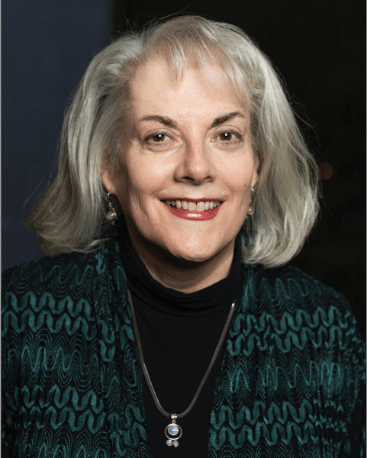
ARLG Member Spotlight: Deborah Collyar, Patient Advocate

Deborah Collyar President Patient Advocates In Research (PAIR Network)

ARLG thanks Deborah Collyar, Patient Advocate, for her dedication and service to its INNOVATIONS Working Group. Her contributions and advocacy for patients with antimicrobial resistant infections have been invaluable to our team.

Learn more about Deborah below and hear members of the ARLG INNOVATIONS Working Group express their appreciation and best wishes to Deb.

How long have you worked with the ARLG and what projects are you most proud of?
I’ve worked with ARLG since 2020 as a Patient Advocate in the INNOVATIONS Working Group. My work included project development and implementation on both the Quality of Life (QOL) and the Desirability of Outcome Ranking (DOOR) Task Forces. With decades of experience as a patient and as a Patient Advocate in antibacterial resistance research (primarily oncology and immunotherapy), I was surprised to learn about the many similarities between cancer cells and bacteria, including the ability to evade and resist known treatments.

Topics that I stressed, most of which were adopted by ARLG, included:

    • Thinking beyond the traditional antibacterial design approach (including many discussions about superiority trials in addition to non-inferiority designs)
    • Expanding approaches beyond antibiotics
    • Identifying patient communities who may be at higher risk for infectious disease (ID) and antimicrobial resistance (AMR)
    • Offering input on different patient perspectives and how to incorporate those into clinical trials
    • Setting up focus groups with relevant patient communities
    • Helping design health-related quality of life (HRQoL) studies and setting DOOR parameters for four different ID medical conditions so ARLG can learn how to set up templates, with FDA input, for use in all AMR clinical trials.

The achievement I am most proud of is directing focus to the person with the infection, not the ‘bug in the tube.’ While it’s important to know whether the bacteria are susceptible/resistant, it is also critical to understand more about the person and how their immune system and other heterogeneous factors impact the drug treatments that are used.


“ARLG is grateful for Deb Collyar’s contributions to the Innovations Working Group. For over four years, Deb has kept our efforts laser focused on the patient’s experience in AMR. She has been a valued colleague, and we wish her the best in the future.”

Vance Fowler, MD, MHS
Professor of Medicine and Molecular Genetics and Microbiology
Duke Clinical Research Institute
Duke University
ARLG Principal Investigator
INNOVATIONS Working Group Member


Why do you feel ARLG’s research is important?

ARLG research offers a chance to improve the way antibacterial clinical trials are developed and implemented so that we can find important answers for both the scientific and patient communities. I hope our industry partners take these important learnings to heart as new trials are developed.

Why do you feel that including the voice of the patient is so important to clinical research?
Patient input helps identify specific needs and issues that patients face every day when dealing with infectious diseases. Many times, these needs are not addressed with traditional clinical trial approaches; yet including patient voices can create better market acceptance once agents are approved.


“Deb has fundamentally shifted the way that I conceptualize and consider the perspective of patients and clinical trial participants. Her advocacy for the patient voice continually reinforces the fact that at the core of every study and treatment plan exists a person whose voice and experience should be guiding our efforts to advance science and improve care of those with antibiotic-resistant infections. I am so grateful for her collaboration these past years and will channel her input into my work for years to come.”

Sarah Doernberg, MD, MAS, FIDSA
Department of Medicine, Division of Infectious Diseases
University of California, San Francisco
INNOVATIONS Working Group – QoL Task Force Co-Lead


What do you plan to do next?
As a Patient Advocate, I am supporting two new initiatives:

      • As Co-Director of the new Institute at One Cancer Place, I’m helping to develop a new approach to reach and teach patients about the language and landscapes of cancers and to develop Patient Leaders and Advocates. I hope this work will spill into some ID areas one day!
      • I’ve also served on the Steering Committee and will continue as a member of the Leadership Council for the newly formed Alliance for Rare Cancers as we build a national system for care and research.

I continue to work on these new roles in addition to many other biospecimen/biomarker-driven projects and clinical trials, as well as translational and other types of research.

My colleague, Ella Balasa, is a great Patient Advocate and will be a wonderful addition to the ARLG team!


“Deb has made tremendous contributions to our Innovations Committee which she has been a member of since we started in the Spring of 2020. This group could not have been successful without Deb. Deb has never been afraid to speak up and constantly reminded us to focus our discussions on what’s important to the patient. She regularly asked challenging and insightful questions and was good at always keeping the ‘big picture’ in mind. Deb is always positive and upbeat and a fantastic person to work with on a regular basis. We will miss her on our regular calls!”

Jessica Howard-Anderson, MD, MSc
Assistant Professor, Division of Infectious Diseases
Emory University School of Medicine
INNOVATIONS Working Group – DOOR Task Force Lead


Is there any other information or thoughts you’d like to share with ARLG members?
I really appreciate the respect and comradery that the INNOVATIONS Working Group was able to build. I look forward to following ARLG’s progress and how innovative efforts will be incorporated into all ID clinical trials by academics and companies. Patients are counting on all of us!

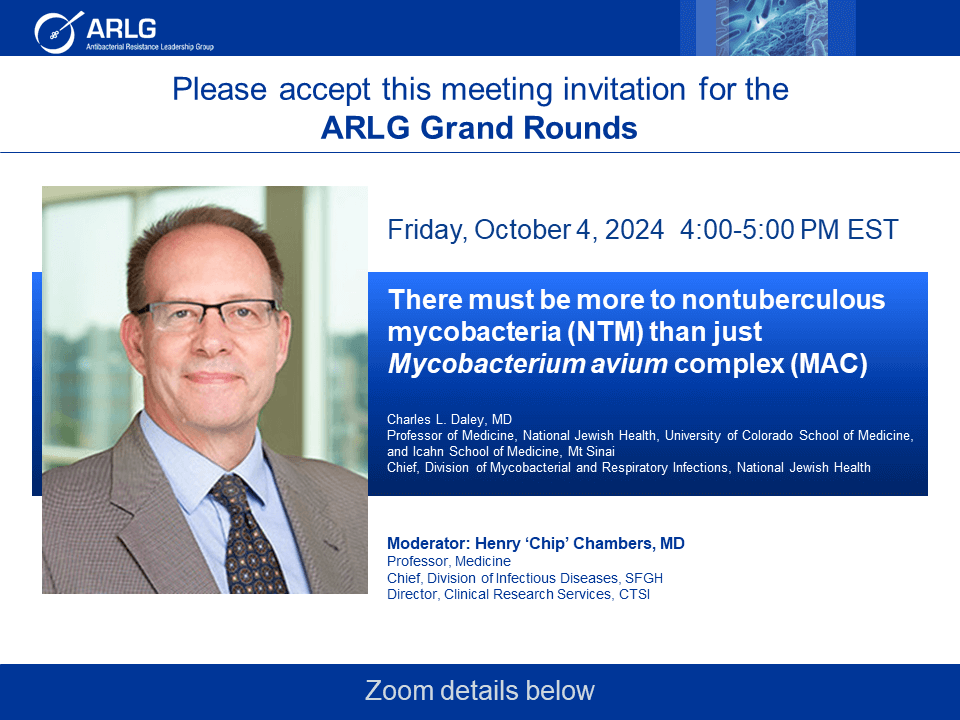
There must be more to nontuberculous mycobacteria (NTM) than just Mycobacterium avium complex (MAC)

ARLG Grand Rounds: There must be more to nontuberculous mycobacteria (NTM) than just
Mycobacterium avium complex (MAC)
October 4, 2024

Charles L. Daley, MD, Professor of Medicine, National Jewish Health, University of Colorado School of Medicine, and Icahn School of Medicine, Mt Sinai. Chief, Division of Mycobacterial and Respiratory Infections, National Jewish Health, Denver, CO


Brave new world: promise and perils of generative AI for ID professionals

ARLG Grand Rounds: Brave new world: promise and perils of generative AI for ID professionals
January 5, 2024

Ilan Schwartz, MD Associate Professor of Medicine, Division of Infectious Diseases, Duke University School of Medicine


View the event slides.

From Data to Delivery ARLG Has You Covered


As part of our mission to support research and combat the threat of antimicrobial resistance, ARLG provides resources that may help researchers improve their data, access specific bacterial strains, or secure funding for innovative study ideas. Learn more about each type of resource and how to request it below.


Concept Proposal

ARLG accepts proposals for novel clinical studies that require funding or other resource support. Investigators who have some external funding available may submit requests for partial funding.

Proposed studies must prioritize gram-negative infections, gram-positive infections, and/or diagnostics. Ideal candidates for concept proposals:

  • Have the potential to transform medical practice by improving use of antibiotics and/or impacting antibacterial resistance
  • Would be unlikely to occur without ARLG support.

ARLG scientific committees review concept proposal requests for merit, feasibility, and novelty. They also evaluate whether the proposed research meets ARLG’s mission “To PRIORITIZE, DESIGN, and EXECUTE clinical research that will impact the prevention, diagnosis, and treatment of infections caused by antibiotic-resistant bacteria.”

Proposal requests must include the research question, rationale, primary hypothesis, planned endpoints, study population, and sample size. If the scientific committees accept a concept proposal, they will ask the principal investigator to submit to a more detailed proposal, which will go to the ARLG Executive Committee for further consideration or approval.

Go to ARLG.org/protocol-concept/  for more guidance.
Select the Submit your Proposal button to apply.


ARLG Study Data Request

ARLG advances clinical research and scientific knowledge by sharing final data generated from NIH-supported studies with researchers to help further their study initiatives. The data can include information from single or combined studies.

 ARLG’s Data Sharing Committee Chair and other experts review study data applications to determine if the information requested will meet the objectives of the analysis. If the study results are pending primary publication to a peer review journal, the committee chair will hold the data until submission.

The data request must include the research description, objectives, rationale, as well as an explanation of how the data will meet the study objectives, and an analysis plan that includes power calculations and statistics. The requestor must also be able to demonstrate that they have the expertise to perform the analysis, including whether statistical assistance is available.

Go to ARLG.org/request-data/ to learn more.
Click the Request Data button to submit an application.


Data Analysis Request

Researchers with a novel research idea can request to have the Statistical Data Management Center (SDMC) perform an analysis on data from an ARLG study or studies.

The SDMC reviews data analysis requests for feasibility and merit. The ARLG Publications Chair, an ARLG Review Panel, and the ARLG Executive Committee may also review requests to determine viability.

The analysis request must include the research description, objectives, and rationale along with an explanation of how the data will meet the study objectives.

Go to ARLG.org/statistical_and_data_management_center/ to learn more about the SDMC.
Go to ARLG.org/request-data/ and use the Request Data button to create a data analysis request.


Bacterial Strain Request

ARLG’s Laboratory Center manages a biorepository of clinical study isolates and well-characterized gram-positive and gram-negative bacterial isolates from published manuscripts. Researchers can request bacterial isolate strains to develop diagnostic tests and novel antimicrobial compounds or to conduct studies evaluating mechanisms of resistance.

Researchers can review available isolate strains by using ARLG’s online Biorepository Strain Catalogue and request up to 80 strains per year for each laboratory or company. ARLG’s Laboratory Center director will review requests for larger numbers of isolates or those not yet published by ARLG.

You may review available strains by visiting the Biorepository Strain Catalogue.
To request isolates (strains), please apply using the ARLG Interest Survey.


Helen Boucher Awarded IDWeek 2022 Maxwell Finland Lecture

Helen Boucher, MD, FIDSA

ARLG investigator, Executive Committee Member, and Innovations Working Group Chair, Helen Boucher, MD, FACP, FIDSA, will present this year’s Maxwell Finland Lecture during IDWeek 2022 in Washington, D.C. Her presentation, “Running to Stand Still: Progress and Perils with AMR”, will highlight the key drivers of antimicrobial resistance and the potential incentives of drug and diagnostic development to treat and detect antimicrobial-resistant infections.

Dr. Boucher is the director of the Tufts Center for Integrated Management of Antimicrobial Resistance and the director of the Infectious Diseases Fellowship Program at Tufts Medical Center. Dr. Boucher has held several other leadership positions in the field of infectious diseases and has authored or co-authored numerous publications. Her research focuses on

The Maxwell Finland Lecture is awarded annually to experts who have contributed to the areas of bacterial pathogenesis, antimicrobial agents, emerging infections, and hospital-acquired infections. It is named in honor of IDSA’s first president, Maxwell Finland, MD, DSci, who was internationally recognized for his work on the incidence and character of infectious diseases and their treatments.

Dr. Boucher will deliver her lecture on Thursday, October 20 at 9:15 a.m. It will be available after the event on-demand through March 2023.


Read more

See the full list of IDWeek 2022 ARLG presenters


July 2021

Our July 2021 newsletter announces an exciting new opportunity for early stage investigators, the Early Faculty Seedling Award! Read more about our fellowship’s new name honoring our colleague, mentor, and friend, John Bartlett, MD. We spotlight early stage investigator, Daria Van Tyne, feature news on Prof. Herman Goossens’ ESCMID award, and highlight a WebMD article with commentary from Vance Fowler, MD and Tori Kinamon.

February 2021

In this issue, we start the year by sharing insight from the IDWeek 2020 Finland Award Lecture delivered by Vance Fowler, MD, MHS and a feature on the passing of John Bartlett, MD who was instrumental in helping to build the ARLG. News updates include a promotion to Professor of Medicine for Yohei Doi, MD, PhD, upcoming events and abstract deadlines, and the announcement of two new FDA fellowships.